
2.1.11 Capture methods
For experts only
To band, track, or collect samples from birds they must first be caught. There are several ways of catching seabirds for research purposes – both on land and at sea. It is important to note that with every method there are risks, and that the bird’s health should always be paramount and a primary consideration.
Note, birds should never be captured or handled unless the people involved have been properly trained in the methods being used, understand safe handling techniques, and are aware of how to mitigate any risk to the bird, as well as having the appropriate permitting in place.
If you do not know how to catch or handle birds, contact experts and arrange for training sessions. If you do not know what the laws are related to capturing and handling birds for scientific purposes, or what permits may be needed, do your homework first!
Methods of restraining captured birds
In each of the examples of capture methods listed below, both on land or at sea, birds once captured will need to be restrained to help calm the birds, and also mitigate against the risk of injury both to the bird and the handler(s). There are kinds of restraint which are used for different handling purposes:
- Bird bags
- Tubes
- Boxes
- Just in the hand
- Sometimes with multiple people
- Capture methods on land
Use of playback as a capture method has been covered above (see Section 2.1.5) as it is also a survey tool to detect presence of birds. Here we will look at methods that can be used to capture birds, both on land and at sea.
Floodlighting, spotlighting
Petrels and shearwaters can be attracted to bright lights, especially young birds. Birds can be found grounded in villages and towns where bright lights are used. Spotlights and floodlights have been used to deliberately attract birds to ground for capture. This method has been used to identify flyways (birds moving from the sea to inland breeding grounds, in the case of species that are nocturnal over land), attachment of tracking devices and to collect samples (blood and feathers) for genetic and diet (stable isotopes) research, for example.

Figure 52. Floodlight on a stand at river mouth, Silur Bay, New Ireland, PNG. Beck’s Petrel project. The inverted V shows the location of the floodlight on a stand and the direction of the beam when used after dark. Photo: André Raine.
Method
As with the use of floodlights, spotlighting and playback (already discussed in Section 2.1.5), the primary capture location requires an open space for the positioning of your flood light. The flood light is then positioned in the centre of the capture area with a baffle cone to direct light upwards in the sky so as not to impact the night vision of field workers. There are a variety of very powerful lights now available on the market – some require a generator, others do not.
A typical capture/recapture session will start with turning on the floodlight and a playback speaker playing the calls of the target species previously recorded at a known breeding site. When a bird is attracted and sighted in the flood light, field workers use two high powered torches or spotlights, as well as headlamps, to attempt to disorientate the bird to bring it to ground in an open area.
When using spotlights or floodlights, care must be taken to ensure birds coming into land don’t crash into anything (e.g., trees, fences, buildings).
Captured birds should then be banded with a unique metal band, the breeding status of captured birds assessed through evaluation of the brood patch, moult scores, and samples (if required) taken. A quick and easy way of assessing whether the same bird is captured again that session is mark the bird’s head with a stripe of white correction fluid, allowing for quick visual assessment if it is captured again. It is then important to go to a release site that is well away from the capture area, to avoid birds flying back in and getting recaptured. If this is not possible, turn off playback and lights while you release the bird, wait five minutes, and then start again. Also, be mindful of any avian predators (e.g., owls at night) which could target birds that are sitting on the ground and reorientating, before flying off.
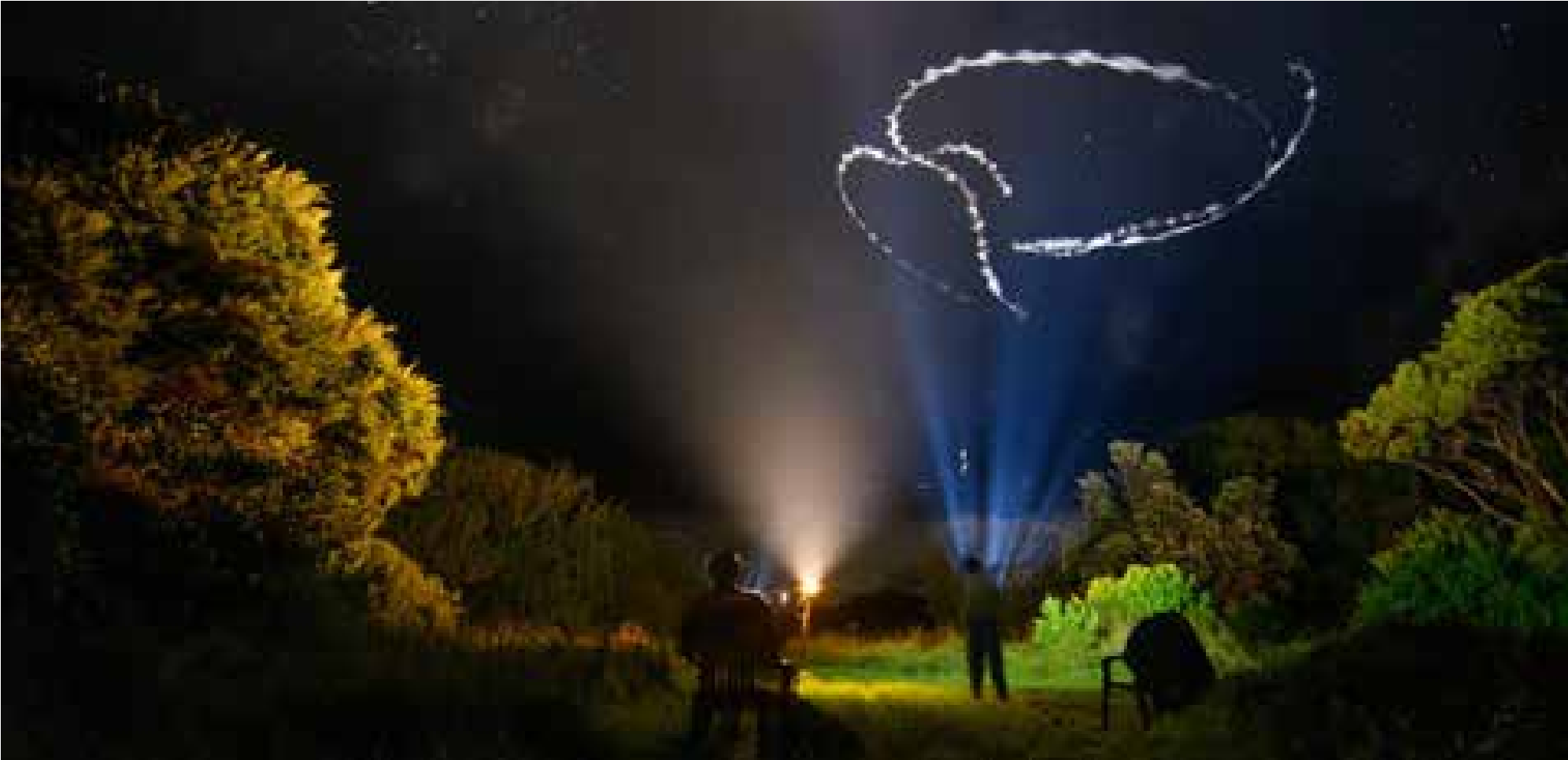
Figure 53. Storm-petrel caught in the light of a high-powered torch spiralling down to ground. The floodlight serves to attract birds into view. New Zealand Storm-petrel project. Photo: Edin Whitehead.
When to use
Research has demonstrated extreme aversion of some petrels and shearwaters to moonlight over land. Accordingly, most field trips using this method should be based around the new moon, with capture attempts finishing earlier or starting later in the night to account for moon rise and set. Also, as with the previous method, be aware that this method results in birds that are potentially disorientated and dazzled. Misty nights, with good cloud cover can improve the success of this method.
If you are considering using this method, first consider whether you really need to do it – bear in mind you are bringing flying birds down to the ground so you should carefully consider whether your project really needs to do this. Secondly, make sure the people doing the work have been trained in this method, as it requires skill and an in-depth knowledge of the technique to ensure birds aren’t injured. Lastly, refrain from doing this in an area where the general public can see what you are doing. As this is an effective capture technique, it could be used by people to harvest birds, which would not help their conservation!
Mist nets
This method can be used on land for capturing small seabirds such as storm-petrels, and potentially small petrels and shearwaters. Combined with playback and also spotlighting, mist nets are safe and effective when used by trained researchers but can be lethal in unskilled hands. In other words, mist nets must only be used by people with considerable experience in their use and hold certification for mist nets through a national bird banding and handling scheme.
The following is adapted from the New Zealand Bird Bander’s Manual.34
Mist-nets are fine mesh nets. Usually, they are set between two poles to capture birds in flight. When set against a dark background such as vegetation they are virtually invisible during the day, and after dark for nocturnal captures the mesh will be invisible. The mesh of the net is supported on two or more horizontal ‘shelf strings’, which have a loop at each end to attach the net to the poles. The netting mesh is strung in such a way that it forms deep pockets that a bird falls into when flying into the net. Note that nets come in different mesh sizes, and this is an important consideration for your target species (using the wrong mesh size can result in birds escaping, or birds becoming seriously entangled or even injured).
The height at which the net is set will depend on the expected flight paths of the target species. When using playback and spotlights birds that are attracted to the lights and playback will circle lower and lower. That means the nets can be set at a height that makes it easy for them to be checked and the birds extracted. Once the nets have been erected, they must be supervised at all times. This may mean keeping the nets in view continuously in some situations, such as when using playback, and when targeting a threatened species. If predators (e.g., owls) are drawn to the capture site, it may be necessary to close the nets and turn off the playback.
Extracting birds from mist nets is a skill that requires manual dexterity and a great deal of patience— not everyone is suited to using this capture method. Each bird caught presents a novel problem to the bander and no amount of written material can substitute for hands-on experience. During the extraction, take great care not to move wings, legs and joints into unnatural positions, as this may cause damage to the bird and increase stress. However, flight feathers can be bent in gentle curves.
If using at night other nocturnal animals can be caught, bats and owls for example. It is vitally important that when the catching is finished for the night the net should be taken down, so birds are not captured when the net is unsupervised. In windy offshore environments, no amount of furling of net (and taped or tied shut) can stop pockets of the net forming potential capture points.
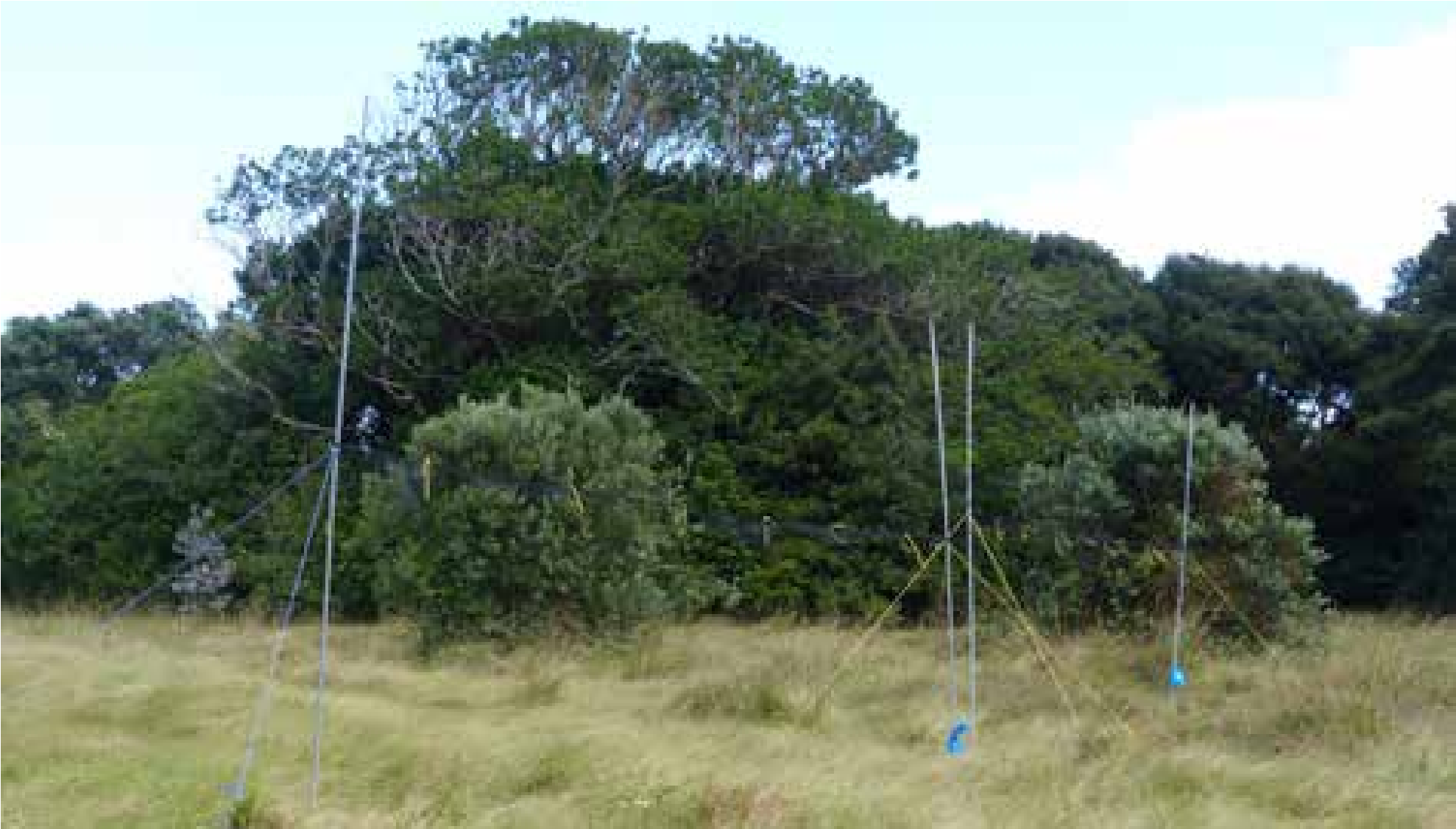
Figure 54. Mist net set up at a New Zealand Storm-petrel catching site; used with flood and spotlights, Te Hauturu-o-Toi/ Little Barrier Island. Photo: Steffi Ismar.
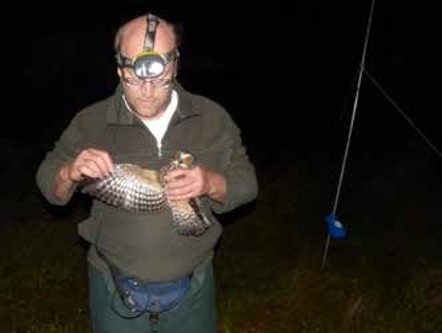
Figure 55. Example of a non-target bird species captured when using a mist net, Ruru or morepork (native owl), Te Hauturu-o-Toi/Little Barrier Island. Photo: Steffi Ismar.
Noose or crook on long pole
This method can be used for catching boobies and gannets which nest on the ground. Approaching from the windward side to where the birds is sitting, either at the nest or roosting site and avoiding capture attempts on low-wind days will reduce avoidance behaviour prior to capture attempts. Capture is accomplished by carefully manoeuvring the pole toward the chosen bird to try not to spook it or its neighbours. Then either the crook (hook) is gently placed around its neck, or the noose is gently draped over the bird’s head and drawn gently closed. With the crook, the bird is pulled towards the catcher. The noose is fitted with a stopper so that it can never be pulled too tight. The bird is then pulled out of the colony, quite unceremoniously, along the ground (so it can continue to take its own weight) towards the catcher. Now the bird can be carefully brought under control where it can, depending on the purpose of the research to be undertaken, be banded, measurements, weight and samples taken, tracking devices fitted.

Figure 56. Australasian gannet about to be captured using a hook fixed to a long bamboo pole, Hauraki Gulf, Aotearoa New Zealand. Photo: Nigel Adams.
Capture by hand
A number of surface nesting seabirds can be captured by hand, such as Red-tailed Tropicbird, Kermadec Petrel (Pterodroma neglecta), Herald Petrel (P. heraldica), Henderson Petrel, Phoenix Petrel, Murphy’s Petrel (P. ultima), and Christmas Shearwater (Puffinus nativitatis). This can be done by carefully approaching the birds, walking very slowly, no sudden movements and crouching when getting close to the bird on the nest. If it looks as though it will take fright and abandon its nest, potentially damaging its egg or chick, take a step back and go down into a crouch and wait for the bird to relax (or abort the capture entirely). When picking up a bird place both hands across its back and, holding its wings tight to its body, carefully pick it up and transfer it to a bird bag head first. Use an item of clothing, e.g., a cap or hat, to cover the exposed egg in the nest against unwanted attention from ground avian predators such as swamphens and rails.
Burrow-nesting seabirds present a different challenge
Birds can be caught while visiting (adults) or present (adults and chicks) in underground breeding burrows. Generally, the tunnels are too narrow to extract the birds with your hands around the body and wings. The standard method is to let the bird bite down on a finger (gloves can be useful) and then apply gentle traction on the bill. The wings of the bird stretch backwards (a normal wing posture when tree climbing for example). Then the body and wings are quickly restrained once they are out of the burrow, as the bill is released. If the bird gets caught up by a root for example, allow it to back up and try again until it comes free and is brought up to the entrance.
To limit distress, the bird needs to be restrained in a dark cotton bag while weighing, sampling, banding, and in some cases, while attaching tracking devices takes place. The bird is then returned to the burrow, placed head-first into the burrow entrance so that it can walk back up the burrow on its own. Chicks need to be carefully lifted from the nest by supporting the body and placed in a dark cotton bag for measuring, sampling and banding. Extra care needs to be taken with chicks – if they have been recently fed, they have a higher tendency to vomit, and their feathers may still be in pin and thus more fragile. Burrow traps or gates can also be installed, which is particularly helpful when recapture of specific birds is important (e.g., to retrieve tracking devices), provided on-site monitoring be maintained during their deployment. Burrow traps can be made with relative ease, for example utilizing a section of Novacoil drainage tube with a swinging gate made from clear acrylic at one end. This is held open with a stick and the gate drops when the bird pushes past it. The design of the gate is such that it only swings inward and cannot be opened from the inside, thus trapping the bird.
The bird is held in the burrow until it has been captured and processed. After processing, the bird is either returned to the burrow (if it is still nighttime) or released in the open to fly back out to sea (during the day). Burrow traps are a particularly useful tool for species that can return to their burrow at any time of night and for species that have very short feeding or stop-over visits to their burrows. During chick feeding, burrow traps are also useful because they allow the adult to enter and feed their chick undisturbed. The adult can then be extracted afterwards – this minimizes the chance of regurgitation of food at a critical stage of chick development.
For species that move fast as soon as they emerge from a burrow if the burrow gate is removed, fish landing nets with soft mesh can be placed over the burrow entrances to catch birds. The mesh needs to be held clear enough over the entrance so that the departing bird can poke its head out and not touch the mesh. Once it emerges then the net can be dropped, and the bird restrained by hands over the net and around the bird.

Figure 57. Burrow traps (gates) in a high-density Buller’s Shearwater colony. Photo Edin Whitehead.

Figure 58. Burrow trap (gate) at entrance to a Hawaiian Petrel burrow. Photo: André Rainé.
Capture methods at sea
For captures at sea, the target birds need to be attracted within range of the device being used: <3m for hoop and throw net, and <10m for a net gun.
Note that all of these methods are highly specialised and should only be carried out by trained personnel familiar with the technique. If you have not done this before, contact experts in the field and seek their assistance in advice and training.
Hoop net
Important factors in making hoop nets include: (1) hoop size, shape, and material for ease of throwing, (2) mesh size to minimize entanglement, and (3) addition of a weighted skirt to reduce probability of escape by diving (e.g., shearwaters, cormorants).
Once a bird is in range, the net is thrown rapidly in a swirling motion, low and parallel to the water, allowing the skirt of the net to open. With the target situated within the perimeter of the hoop, the lead line is able to sink, thus enveloping the bird. The birds’ buoyancy and lightweight pipe frame keep the net afloat as it is drawn to the boat using the attached nylon line. When within reach (<1 m), birds are then gently restrained in the netting as the hoop-net is lifted into the boat. Once in the boat, the bird is then removed from the netting and placed in a bird bag.35
Cast or throw net
A hand cast net (2m diameter) with monofilament mesh has also been used for catching petrels and shearwaters in Aotearoa New Zealand (e.g., Black Petrel (Procellaria parkinsoni) and Flesh-footed Shearwater (Ardenna carneipes)). In this case, the net is thrown by one person from the back of the boat, whilst the other team members throw bait or chum to attract birds within range (i.e., chumming) and/or help with processing the captured birds. Once a bird is targeted with chum, it is lured in until it is within range of the cast net thrower. The cast net is then pulled tight once over the bird(s) to seal them inside and bring them back on to the boat, similar to catching small bait fish. The bird(s) is carefully retrieved from the net by hand, and then each bird is placed into an individual drawstring bag for processing later.36
Net gun
The net gun fires a net from an open holder fixed between four barrels. The safest and most commonly used propellants are compressed air, with the net gun filled from a dive tank. Projectiles in the barrels are attached by cord to the four corners of the net. When the trigger is released, the propellant forces the projectiles out from the barrels, dragging the net with it. The barrels are angled out so that the net opens and expands as it moves towards the target. The angle between the barrels and the power of the net gun determine the distance the net flies before reaching its maximum extent. Beyond that point the net will start to close in on itself while still in flight, so birds are captured before the net reaches that extent.
Various designs of net guns have been developed specifically for the capture of seabirds at sea, principally in Aotearoa New Zealand since 2006 with application internationally. While many species can be attracted to chum, and to come close to the boat (i.e., within range of the net gun), the net guns have proved to be particularly useful for capturing highly manoeuvrable birds such as petrels, shearwaters, storm-petrels and even shags (cormorants) in flight.
As with some of the other methods described in this manual this is a very specialised capture method and requires specific training.

Figure 59. Use of a net gun for the capture of a Black Petrel from a vessel for a mark recapture population study, three albatross in proximity, undisturbed, northern Aotearoa New Zealand. Photo: Edin Whitehead.
Other methods
In some cases, birds come so close they can be picked up by hand. For example during migration periods when birds are very hungry, some species (such as Great Shearwaters) can be attracted to the side of the boat with chum and captured by hand while they are still sitting on the water. Night captures are possible when boat lights dazzle birds, causing them to land on the deck, allowing them to be captured by hand.