
3.13 Monitoring pest control measures
Paula A. Castaño, Paul Jacques, Richard Griffiths, Island Conservation
For some seabird conservation projects, invasive species eradication is possible but often this is not feasible for technical or socio-political reasons, in which case control may be the only management strategy to prevent further biodiversity loss.91 Eradication of introduced predators such as rodents, cats, pigs, and mongooses, can result in very positive outcomes in short periods of time with seabirds breeding successfully and expanding their breeding distribution. Additionally, removal of invasive competitors (e.g., rabbits) that outcompete seabirds for breeding burrows can also result in positive outcomes for ground nesting seabirds, with some species returning to islands to breed successfully after several decades.
At Midway Atoll National Wildlife Refuge, United States, for example, Bonin Petrel (Pterodroma hypoleuca) populations increased from fewer than 5,000 nesting pairs in the 1980s to over 135,000 pairs in 2008 after the eradication of rats in 1997.92,93
On Hawadax Island, Aleutian Islands, United States, 10 years after the removal of rodents Tufted Puffins (Fratercula cirrhata), not previously recorded as breeding on the island, were documented. Many other similar examples exist where seabirds have benefited from the removal of invasive predators/pests from islands around the world.94
In areas where total eradication of invasive species cannot be completed, other invasive predator management systems can be implemented such as pest control using tools such as traps, firearms, toxins or predator fencing to exclude invasive species from an area. Predator control can be implemented to prevent the loss of species until eradication becomes feasible or an alternative such as fencing can be deployed.53,95 In contrast to eradication, pest control only supresses the invasive species’ population and benefits to the seabird species of concern will only be apparent for the period of time the tool is deployed, . However, in some instances it can be the only management strategy available to prevent a species from completely disappearing. For example, in the Galapagos Islands, the largest breeding population of Galapagos petrel (Pterodroma phaeopygia) in the world was successfully sustained on Cerro Pajas, Floreana Island, thanks to an extensive and long-running control program targeting introduced rodents, feral cats, pigs, goats and donkeys. This effort has been led by the Galapagos National Park and undertaken annually since the 1980’s,96 with feral pigs successfully eradicated at the end of the 1980’s and goats and donkeys successfully eradicated by 2011.97,98,99
Pest control techniques and tools should be chosen carefully based on best practice for the predator/ pest species targeted. Other factors that will play into selection of tools include the size and accessibility of the site, local climate (e.g., rainfall), availability of funding, and logistical limitations (e.g., access, number of available fieldworkers). It is also essential to consider the impact of suppression tools on native non-target species to ensure that tools do not cause unacceptable levels of primary or secondary mortality. For example, if you are considering conducting rodent control using anticoagulant rodenticides, depending on the avifauna of your site there may be a possibility that other species will be negatively impacted (e.g., raptors or other native predators), through secondary exposure. Mitigation actions may be required to ensure that these non-target species are not impacted. Check regulatory requirements when considering the use of tools to make sure you can legally use them in your area. Additionally, ensure that you have conducted extensive outreach efforts to ensure that communities and stakeholders have all of the facts available to them as misinformation can be damaging.
Predator fencing greatly increases the effectiveness of existing animal control efforts, shifting the focus from perpetually attempting to control predator numbers, to eradication and surveillance.100 Predator fencing makes it feasible to remove all animals from within the fenced unit and focus control efforts on buffer areas around the fence’s perimeter. In Aotearoa New Zealand and Hawai’i, predator exclusion fencing has been used to successfully recover seabird populations with extraordinary results.101 The fencing excludes all species of rodent and other mammalian predators and prevents animals from digging under or climbing over the fence.102,101,103 Resource managers in Aotearoa New Zealand have built more than 52 predator fences that protect more than 10,000 hectares. At least eight fences have been built across the Hawai’ian islands. These fenced areas now serve as refuges for endangered seabird species.
To measure the impact of your predator/pest management effort (e.g., eradication, control or predator fencing), a robust monitoring program should be designed and put in place prior to the intervention. Collecting data before an intervention is undertaken is important for establishing baseline conditions against which data collected later can be compared. This is important to determine if the intervention is successful, if any adjustments are required, or if additional interventions are required. Further it can allow you to share stories about the positive impacts of your intervention on the ecosystem and conservation target.
Assessing the effectiveness of pest management will require an initial focus on determining if our control, eradication, or fencing plus eradication efforts have been successful in reducing the threat to the conservation target species. Have they supported increased breeding success and recruitment of individuals into the adult breeding population (e.g., seabirds’ burrow occupancy rates, fledging success, breeding distribution, etc.). Monitoring programs should also wherever possible measure other impacts on the environment.
For pest control operations, where the target is not reduction of the invasive species population to zero as in eradication, it is recommended that the aim be to reduce the target pest population to a predetermined threshold, as measured by standardised monitoring techniques. Prime examples are aerial baiting operations on the Aotearoa New Zealand mainland designed to suppress rats, brush-tailed possums and mustelids, to protect native biodiversity. The success of these operations is determined by assessing the relative abundance of pest predators using techniques such as chew cards (for possums) and tracking tunnels (for rats and mustelids) before, and after, the operation.
Detection methods for determining success of eradication (including within a fenced area) or control will vary by species and can include searching for sign of invasive predator (e.g., footprints in appropriate sites, faeces, gnawed seeds, seabird carcasses, egg or chick predation), spotlight searches, snap traps, live capture traps, chew blocks, wax tags, inked footprint tracking tunnels, dressed timber stakes soaked in peanut oil, candles, lard, chocolate, wax block baits secured in bait stations, wooden boxes providing shelter and wood shavings as nesting material, trail cameras, thermal drones, and trained indicator dogs. Prior to selecting the tools to be deployed for confirmation of success such as snap traps, an assessment of the possible impacts that these can have on other native species (e.g., passerine birds, rails) should be assessed to prevent causing additional harm to these species including our conservation target species.
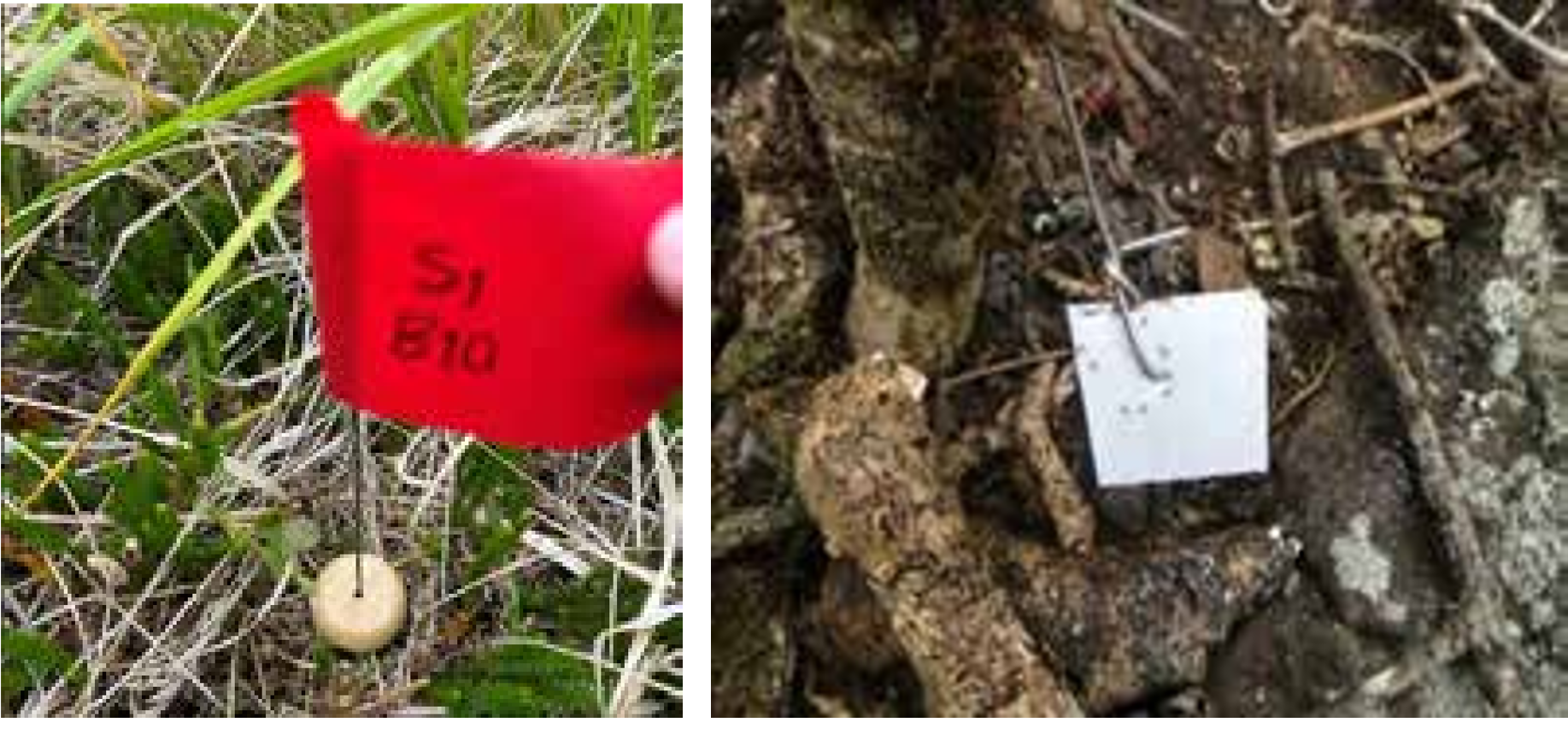
Figure 125. Left figure shows chew blocks deployed for detecting rodents in Great Sitkin, Aleutian Islands, United States prior to eradication. Right figure shows chew cards with peanut butter deployed across Pinzon Island, Galapagos, Ecuador for confirming rodent eradication.
To confirm the success of any pest/predator eradications in particular you should employ multiple detection tools. The amount of effort required to confirm absence will vary on the size of the site and the target predator/pest species, but as a rough guide at least two reliable methods should be used. It is critical to select methods that have been proven previously in the island to have a high probability of detecting your target predator/pest species. Devices (e.g., traps, tracking tunnels, trail cameras, etc.) can be spaced in a grid-pattern, in transects, or may target specific landscape features where the target species of removal may be more likely to be encountered. This latter spacing is particularly useful for animals like feral cats that are not distributed evenly across space but frequently use defined landscape features (e.g., human and game trails) and will concentrate around seasonal food sources (e.g., colonies of terns and burrow-nesting seabirds).
Timing of monitoring success of eradications will vary depending on the target species. For larger and more detectable species such as feral pigs and feral cats it is typical to search for survivors immediately. For operations targeting these species it is only possible to determine in retrospect when the last individual was removed, and the last months of the operation are spent in continuous detection efforts to build confidence in the absence of the target predator/pest. For rat species a low population of individuals is much harder to detect, therefore success should be confirmed one to two years after the eradication attempt. This allows for at least two breeding cycles in temperate islands and possibly more (three or four) on tropical islands, for these rapidly reproducing animals, and greatly increases the detection probability if rats have survived, conversely reducing the amount of effort required to confirm absence.
Detection tools will support you when determining if additional interventions are required, for example if monitoring reveals that not all invasive predators were removed within a fenced area or from an island, or if you should consider moving from a suppression strategy to a more permanent solution like eradication or an intermediate intervention such as predator-proof fencing. Monitoring may also reveal other threats, e.g. detection of previously undetected predator/pest species that may require further management.
In addition to confirming the success of eradication by not detecting invasive predators in the treated area or by reducing their impact on circumscribed areas, a crucial component that allows for measuring the positive impact of invasive species removal on the island environment and the recovery of impacted seabird populations is monitoring from ridge-to-reef. This monitoring assesses the restoration of the treated island or area and its surrounding ocean ecosystems, as well as the re-establishment of locally extirpated seabird species. A growing body of scientific research suggests that significant loss of native connector species, such as seabirds, leads to nutrient cycle disruptions that can result in reduced marine productivity and poor coral reef health104. Measuring ecosystem-scale impacts requires a holistic approach and relies on a carefully considered strategy, beginning with the collection of pre-eradication data to enable measurement of change at pre-determined intervals (e.g. one-, two-, five-, and 10 years) post-eradication.
Conservation impact monitoring (pre- and post-eradication)
Here we provide information on methods that could be used to measure the positive impacts on the seabird species of concern. For additional information on standardised methods for terrestrial and marine monitoring we invite you to visit and consider joining the Island Ocean Connection Challenge. This challenge aims to strengthen our understanding of island-ocean connections by completing systematic, standardized and repeatable terrestrial and marine monitoring before and after the eradication of invasive mammals, while supporting the restoration of critical island habitats.
To document change in seabird abundance and diversity post-intervention it is recommended to combine highly effective population monitoring techniques (via acoustic recorders, population counts, and/or sampling plot nest counts) with generalised, island-wide data collection for evaluation of the seabird community. The metrics often used on islands to monitor the impact of invasive predator/pest removal or control on seabird populations are relative abundance, population size/abundance, and diversity. For determining the most appropriate survey method, it is highly recommended as previously indicated within this manual to consider the breeding phenology and synchronicity of the seabird species of interest as well as the nesting habitat.
Acoustic monitoring is ideal for vocal species that may be difficult to detect due to habitat (e.g., forest, inaccessible cliffs), dispersed nesting (i.e., don’t have centralised colony), nocturnal behaviour, or rarity. In addition, this tool can be deployed for long periods (e.g. years), allowing for a more reliable comparison between seasons and years, which is especially important for asynchronous breeders or those species that don’t have a consistent breeding season. Unless the site is too small, a minimum of eight devices should be deployed on each island across suspected seabird habitats, at least 200m apart. Devices should have mixed diurnal-nocturnal recording schedules and sufficient battery life and memory card storage to allow for continuous recording for up to one year.
Colony or nest counts are ideal for species with nests/individuals that are highly detectable, the nesting area is accessible and at least somewhat centralized (e.g., observers feel confident they are detecting birds or nests in the habitat). In addition, the total numbers will be most accurate for species that have a synchronous breeding cycle; repeating surveys multiple times throughout the year is best for asynchronous breeders. Nest counts that include a complete count of all individuals and active nests of a species are recommended. Searches can be conducted in-person or using aerial imagery (e.g. drone) and should cover the species’ preferred nesting habitat ideally during an early stage in the breeding cycle. Mapping the distribution of nests (e.g. perimeter of colony), marking individual nests, or describing the area searched (e.g. 10m-wide coastline swath) are ways to describe the current distribution of nests.
If a true census or count of all individuals is not possible, because nesting is dispersed across a relatively large landscape or not feasible because of the abundance of nests, sampling plot nest counts may be the best survey option. Plot site selection, size, and number will depend on the species being monitored and the habitat. When possible, a random sampling design is preferred; however, where nests are grouped or there are multiple habitat types that need to be surveyed, stratifying the sampling locations by habitat type is best.
Whether deploying bird point-counts from the coastline or by boat independent of other seabird monitoring methods or in tandem, the point-count methodology offers valuable information for understanding seabird population trends. We recommend the use of boat-based point counts on islands with lots of vegetation while islands with rough ocean conditions or open landscapes may be more conducive to coastal land-based counts.
In either case (or a mix of both land and sea), pointcounts should be conducted from five to ten established, replicable locations around each island (sites distanced at least 200m apart and ideally paired with remote sensing devices). Morning surveys involve spending five minutes per site (50-150m from shore) recording all birds heard or seen, noting whether birds are on island (roosting or nesting) or flying over land or water.
Once data is collected it should be processed and shared with partners to support future conservation efforts for our conservation target species.