
3.3 Sampling from seabirds
Probably not relevant for Palau at this point.
Seabirds should only be handled by people who have been properly trained.
By taking certain samples there is the potential for gathering detailed insight into the health of seabirds at both the individual and population level, and/or to obtain the sex of the bird. Depending on the question and the desired monitoring outcome, samples can vary from completely non-invasive (e.g. collected dropped feathers or faecal samples under roosts/in colonies), or more targeted (e.g. collecting blood or feather samples from birds). These samples can have a variety of uses, some of which are discussed below, and there are many different methods that can be used to obtain and process these samples. Adequate training from an expert is prerequisite to utilising some sampling methods, as well as the relevant permitting. Appropriate containers for samples to be gathered are needed from small plastic Ziplock bags to vials with 70% ethanol or buffer solution added depending on the sample.
- Feather samples: Feather samples are useful for dietary studies (using stable isotope analyses) and in the monitoring of stress hormones and contaminants like heavy metals. They can also be used to obtain the sex of the bird. Due to regular moulting, feathers can provide a time-integrated signal of conditions experienced during the period of feather growth – this is usually during the non-breeding season for adults (when considering flight feathers), and while in the nest for chicks/fledgelings.
Feathers can also be plucked from the bird, but this should be done after suitable training, and only the number of feathers needed for the research should be removed. For DNA sexing only the quill tip is used so feathers must be plucked from the skin and avoid touching the tip. Store in a secure labelled bag. Normally 3-4 feathers are plucked per bird. - Faecal samples: Faecal samples can assist in gathering dietary data via DNA sequencing, and hormonal assessments to better understand stress and breeding status.
- Blood samples: These are perhaps the most versatile of samples, but more invasive to obtain, and require specialist training. Blood samples can offer insight into multiple measures of health and energetics, nutrition, stress and reproductive hormones, immunological activity, diet, and the presence of contaminants as well as assessing the sex of the bird. For petrels, an option now available is to gather a sample of blood on a range of individuals in the breeding population73. From this, the age range of birds can be relatively accurately determined, allowing targeted management depending on the outcome. For example, a population of mostly older birds would suggest that reproductive output is compromised, such as post-fledging survival.
- Swab samples: Preen gland, choanal, and cloacal samples can all be obtained by swabbing. They can be used in a variety of investigations, including pathogen risk (e.g. avian influenza monitoring).
Ectoparasites: Seabirds play host to a variety of ectoparasites, some of which are species-specific. These can be easily sampled for a better understanding of parasite loads and potential risk factors (e.g. disease). The feather lice species often live on different parts of the body so check on wings, around the head and on the lower belly. - Regurgitates: A direct method of studying diet can be from collecting regurgitations. Some species readily regurgitate as a self defence mechanism, which can facilitate sample collection. Depending on the state of these samples, species can be identified visually or via DNA methods, and, if the samples of prey are frozen soon after collection, they can be further analysed for energetic and nutritional content. Two-level sampling can sometimes be achieved where the stomach contents of seabird prey can be investigated for their own prey items, highlighting food-web interactions between seabirds and lower trophic levels. Other items may also be noted such as presence of plastic.
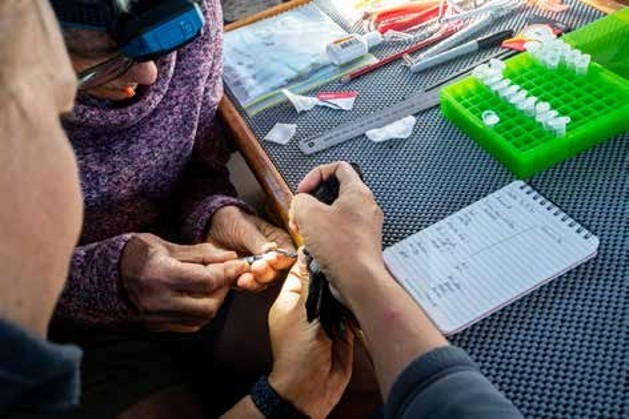
Figure 114. Collecting blood samples from a New Zealand Storm-petrel captured at sea for a genomics study. Photo: Jochen Zaeschmar.