
3.8 Monitoring stress
Probably not relevant for Palau at this point.
A useful tool in the conservation biology toolbox is the ability to measure stress in wild populations. Understanding how a population is faring in response to changing environmental conditions can take time when using demographic measures such as breeding success and population trend data, which require several years to collect. Ecophysiology (how internal physiology relates to the ecology of an animal in response to their environment) can offer more rapid insights into the stress experienced by seabirds. It is commonly used to understand how environmental conditions impact the ability of birds to breed successfully, or how food shortages can impact chick growth and development. Paired with behavioural and dietary data, ecophysiological techniques can assist with routine monitoring of seabird populations.74
Ecophysiological tools are varied. In this chapter we provide an overview of some commonly used methods, using either blood, feather, or faecal samples from seabirds. A consideration for using these methods is having good baseline data from ‘healthy’ individuals and populations for comparison, and some of these data do already exist from studies of Pacific seabird species.
Method
Haematology and blood nutrients: Small blood samples can be used to gather data on the health status of birds (energetic expenditure, hydration, nutritional status, white cell ratios). Red-cell parameters of haematocrit (proportion of red cells to plasma), haemoglobin, and cell counts can be used to calculate further parameters of cell size and haemoglobin content to assess physiological condition. As red blood cells have a turnover rate of around 35-45 days, they form an integrated measure of body condition over several weeks, although short-term acute stressors (like dehydration) can impact this. Blood nutrient analyses can be done with electronic point-of-care devices such as blood glucose metres, and there are some devices that measure a whole suite of blood parameters which have also been validated for use on birds.
Endocrinology: Assessments of stress in wild populations commonly use the avian ‘stress’ hormone corticosterone as a measure of how seabirds are responding to environmental stressors such as food shortages, or human-related ones such as tourism impacts. Corticosterone can be measured from:
- Blood samples (provided these are taken within 3 minutes of first disturbance, to capture ‘baseline’ circulating levels) to capture short-term changes,
- Faecal samples provide a more time-integrated measure, or
- Feather samples allow assessing relative amounts of circulating hormone during the feather growth period. Feather samples are particularly useful from chicks, as they capture the development period in the nest, while for adults they will represent the period following the previous moult.
When to use
Ecophysiological data can be used to assess population condition over time (between years), or to compare between colonies. The expertise required for the analysis of some types of samples in laboratories can preclude this as being too expensive, however in some cases, samples like feathers can be archived as they are stable over time and could contribute to long-term studies of seabird health in response to climate change.
Data management and analysis
Once baseline values and reference ranges are gathered, it is straightforward to plot the distribution of values annually to assess shifts in the variance and mean value of ecophysiological parameters. Formal statistical testing is recommended for determining relevant shifts at the population level, and other data should also be incorporated where possible (bird mass, diet data, behavioural data) to better understand how seabirds respond to change.
Related use of data gathered
The power of ecophysiological data is realised when used in combination with studies of behaviour and diet to gain a holistic view of the status of seabird populations. By undertaking these integrative studies, it is possible to gain a better understanding of how seabirds respond to changes in their environment. Incorporating these tools into routine monitoring will help provide information of seabird condition within a timeframe that allows for adaptive responses to help conserve at-risk populations (Fig. 120).
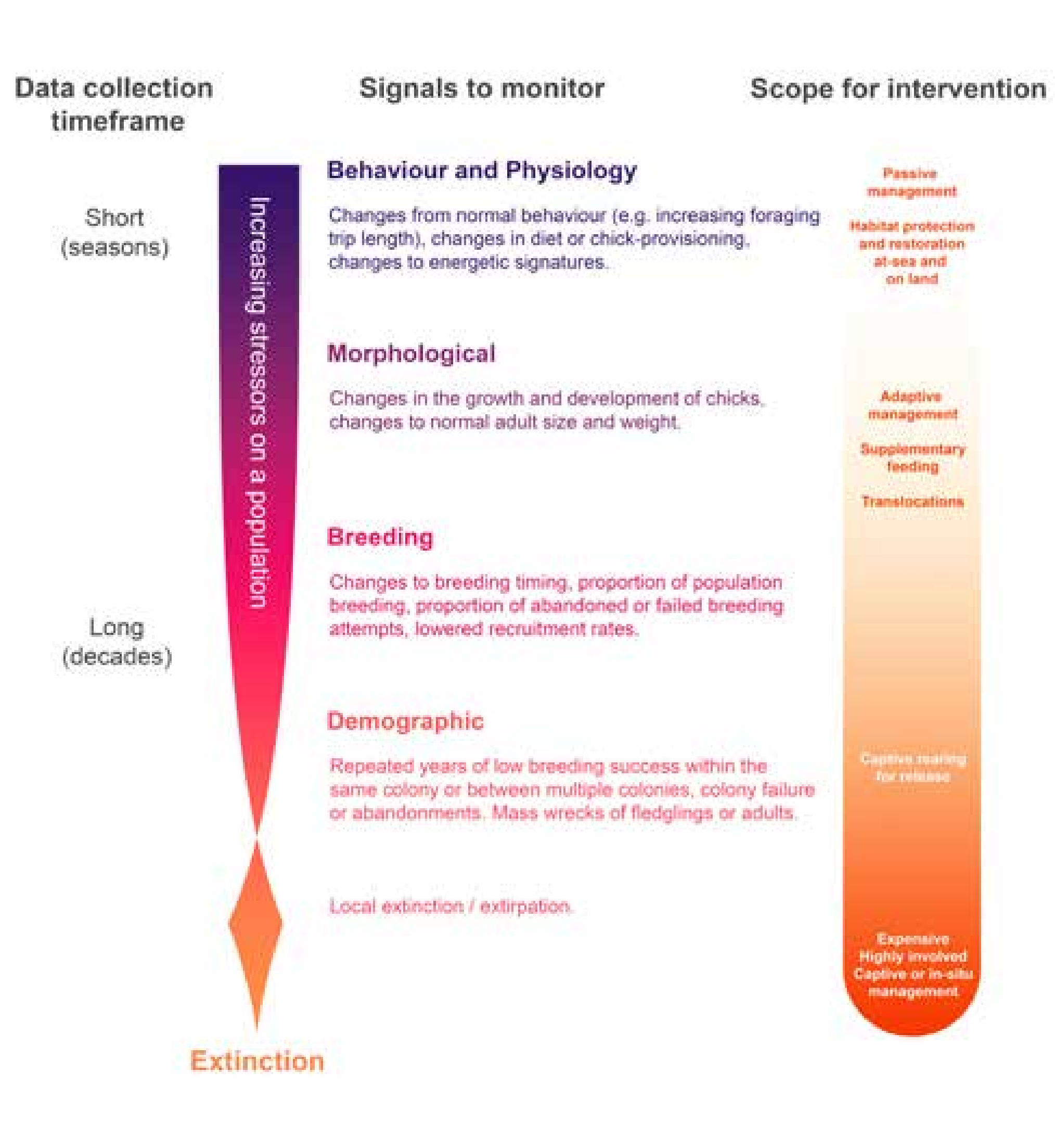
Figure 120. Monitoring populations under stress. An outline of the sequence of signals to assess in seabird population monitoring, the timeframe of data collection, and examples of the scope for intervention when looking for signals of stress at each stage.75
For a thorough review of accessible ecophysiological tools see 74 (References).