
2.2.12 Finding breeding sites
There are at least five species of seabirds in Oceania for which breeding sites are either entirely unknown or not confirmed, and other presumed extinct species that may still be clinging to existence somewhere. It is also possible that there are more, undiscovered species or subspecies waiting to be found. Locating the breeding grounds of these species should be considered a critical seabird conservation priority. With each project of this nature the broad goals would be to:
- Find the breeding site,
- Once located, assess immediate threats and feasibility of critical management actions (such as predator control or eradication),
- Develop local conservation management capacity.
The first of these may seem particularly daunting for such rare and cryptic species and several of the methods described in this manual will be required to achieve this goal. However, there are several recent examples where this has been successfully undertaken. Examples include discovering a breeding location (including burrows!) of a previously thought-to-be extinct seabird (see section 2.1.12 CASE STUDY – New Zealand Storm-petrel) and narrowing down the probable breeding grounds of the Beck’s Petrel by tracking a bird captured at sea (see section 2.1.12 CASE STUDY – Beck’s Petrel).
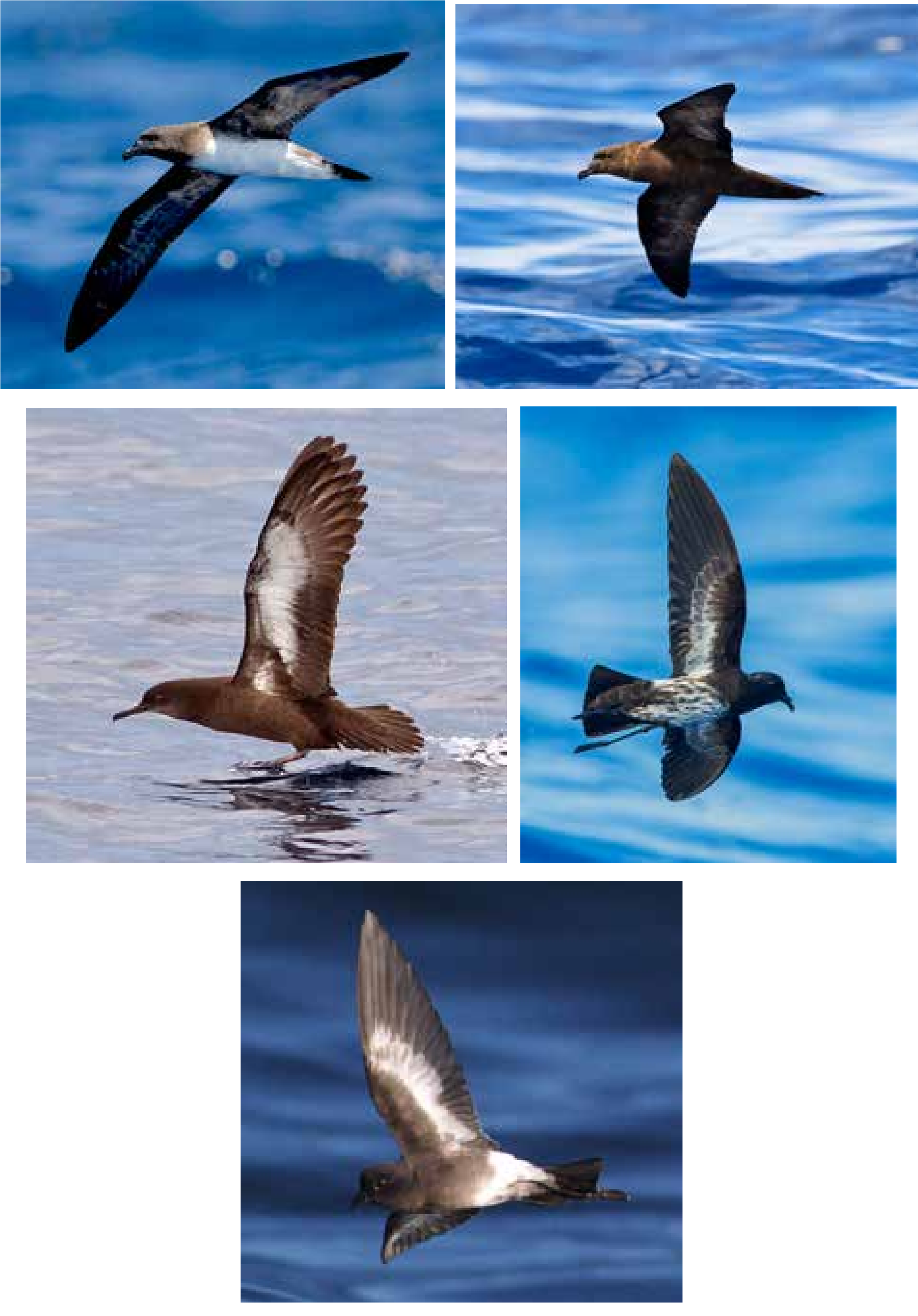
Figures 94-98. Five species for which breeding sites are unknown. Top left: Beck’s Petrel (PNG), Top right: Fiji Petrel, Middle left: Heinroth’s Shearwater (PNG, Solomon Islands), Middle right: New Caledonian Storm-petrel, and Bottom: Pincoya Storm-petrel (Chile). Photos: Hadoram Shirihai (3), Peter Harrison (2).