
2.1.12 Case study - Monitoring surface-nesting behaviour of Kermadec Petrels
Nicholas Carlile, Æstrelata Restorations
The surface nesting Kermadec Petrel is dispersed on remote islands throughout the tropics and sub-tropics. In this case study, their breeding ecology was examined on Phillip Island, Norfolk Group in the South Pacific49. Based on observations of 60 pairs and data gleaned from GLS devices, it was determined that breeding (incubation and provisioning) occurs in all calendar months of the year, with a laying peak in the late austral spring. This broad period of on-island activity is unlike most other petrel species.
The GLS devices used had a guaranteed 3-year battery life and 3-5 years of data storage capacity depending on settings. They were attached either using a hook and loop (Velcro) cuff fitted to the lower leg or a cable-tie arrangement using two Darvic50 bands glued endon to increase the base platform size on the bird’s leg.
Where possible, nests were monitored using surveillance cameras generally set to record images hourly. These allowed hatching and fledgling dates to be accurately recorded. At specifically selected nest sites (where false camera triggers were likely to be a minimum) cameras were set to trigger based on movements. These additional units allowed incubation shift changes and subsequent provisioning visits to be recorded. This information allowed calibration with GLS-derived data when both adults carried the devices. Cameras were serviced bi-monthly. The graphical interpretation of the data was used to assess whether birds were at sea or on-island.
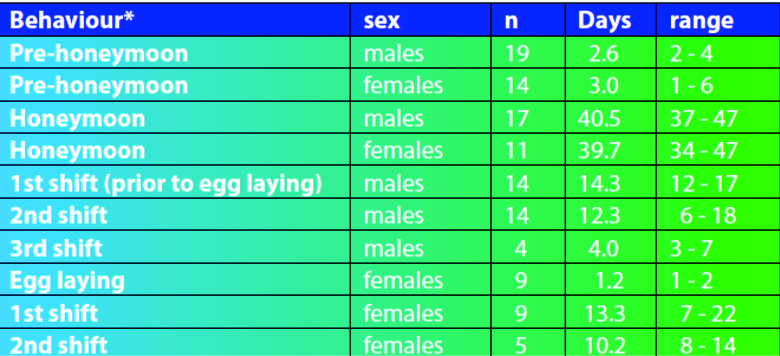
A range of behaviour of breeding birds carrying GLS devices could be gleaned over several seasons of monitoring due to their surface nesting behaviour. Table 2 indicates the level of detail collected on Kermadec Petrels. Determination of provisioning activities was not possible as these occurred both during daylight and nocturnal periods. It could also not be determined when adult visits were without actual provisioning (just visits). The low number of surveillance camera monitored nests (using movement triggers rather than time lapse) during this study period did not allow the inclusion of this information.
Table 2: Island attendance and pre-chick provisioning activities of Kermadec petrels from 4.5 years of surveys (January 2017 to June 2021) on Phillip Island, Norfolk Group.
Because of year-round breeding, visits to the colony were bi-monthly to necessitate both breeding activities of individual nests and to maximise the attachment and recovery of GLS devices. Between January 2017 and January 2024, 117 loggers were fitted to breeding birds. Sixty-five were subsequently recovered with multiple tracked individuals collecting over 65,000 estimated at-sea positions. Time coverage from combined fittings equates to 100 years of at-sea positions. The core breeding distribution at sea (core 50% kernel) covered 1.3 million square kilometres around Norfolk Island Group. The nonbreeding movements of Kermadec petrel from Philip Island, Norfolk included territorial waters of China, Japan, and the Philippines in southeast Asia as well as the south and mid-Pacific island groups of Papua and New Guinea, Solomon Islands, New Caledonia, Vanuatu, New Zealand, Fiji, Samoa, and Hawaii.