
1.3.1 Case study - Palmyra Atoll, Northern Line Islands (US)
Alex Wegmann, Katie Franklin, Dana Sabine, Nick Holmes (The Nature Conservancy)
Palmyra Atoll (“Palmyra”) is at the north end of the Northern Line Island Archipelago lying 1,600 km south of Honolulu, Hawai’i, and 210 km northeast of Teraina Island (KI). It consistsm of 39 islands totalling 235 ha of land surrounded by 2,600 ha of coral reef. Today, Palmyra is a Nature Preserve managed by The Nature Conservancy within a National Wildlife Refuge managed by the US Fish and Wildlife Service, within a 53,000 km2 marine protected area. Eleven seabird species currently breed and roost at Palmyra and it is thought that eight additional seabird species were extirpated with WWII-era habitat disturbance and the introduction of rats.
For over two decades, a confluence of conservation interventions and scientific investigation at Palmyra has shed light on the functional role of seabirds in atoll ecosystems. A 2012 study6 described a positively correlated interaction chain whereby native forest habitat is associated with seabird abundance and seabird abundance is associated with beneficial nutrients (N, P) transported by seabirds and deposited as guano. The guano drives primary productivity on islands and in nearshore marine habitat. Related research7 found that the atoll’s tree-nesting seabirds were responsible for the bulk nutrient transport, i.e., Red-footed Boobies (Sula sula) and Great Frigatebirds (Fregata minor) in particular greatly prefer native tree canopy over coconut palm crowns for nesting and roosting. However, the majority of Palmyra had been converted to a coconut palm plantation, with the result that seabird populations plummeted, and the benefits associated with seabird guano was excluded. This exclusion had cascading effects on soil nutrient loading, terrestrial biodiversity, and overall biomass of native species.
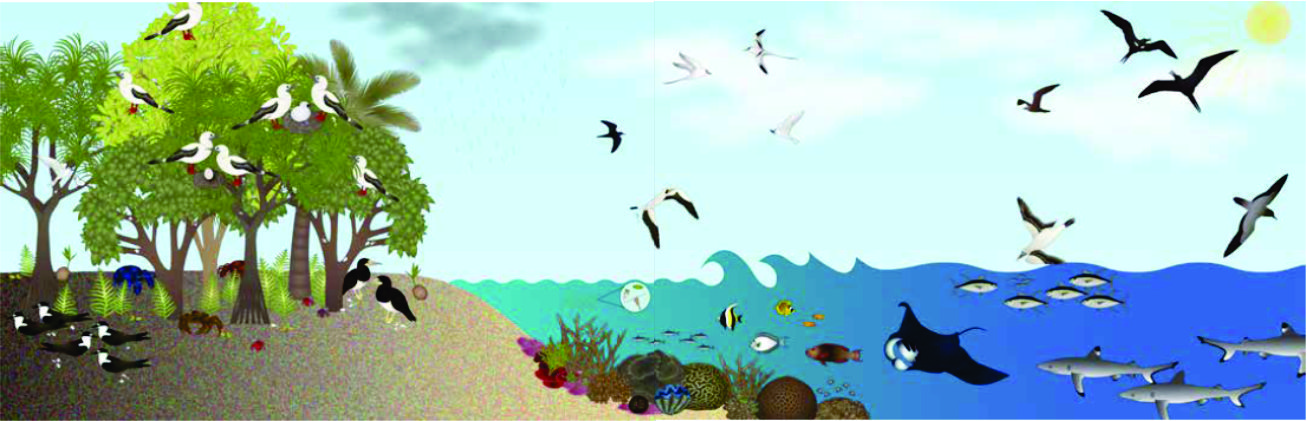
Figure 12 (below). Palmyra land-sea connectivity panorama: Atoll ecosystems comprise island, lagoon, coral reef, and pelagic habitats all tightly connected through myriad biological interactions and physical processes. Seabird transport of nutrients (N and P) from pelagic foraging grounds to atoll islands subsidises productivity along the entire interaction chain, from forest to reef. Artwork Adi Khen.
In recognition of the ecological importance of seabirds as connector species integral to island ecosystem resilience to climate impacts,8 rats were successfully eradicated from Palmyra in
20119 and conversion of the atoll’s abandoned copra (coconut palm) plantation began in 2019.10 This work is on-going and continues today.
See section 3.11 Seabird-transported nutrient monitoring for multiple methods for monitoring the functional roles’ seabirds play in island and marine ecosystems.
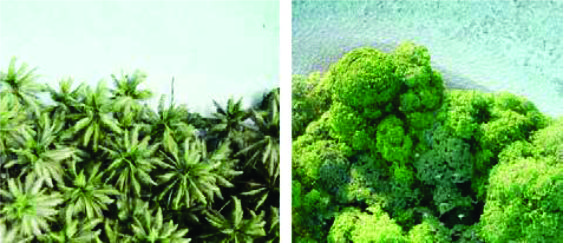
Figure 13. An abandoned copra (Cocos nucifera) plantation at Palmyra Atoll (left) with little to no seabird breeding activity contrasted with native forest (right) with ample seabird breeding and roosting. Photos supplied by: The Nature Conservancy.