
2.2.2 Threat assessment
Paula A. Castaño, Paul Jacques, Richard Griffiths, Island Conservation
As previously indicated within this manual, seabirds face a wide and increasing range of human-induced threats to their survival worldwide. One thing all seabirds have in common is that they must come ashore to breed, and it is during this period that they are often the most vulnerable. On land, introduced and invasive alien species are the most prevalent threat to breeding seabird populations, although urbanization (including threats such as powerline collisions), disturbance light pollution and illegal or unsustainable harvesting of eggs, chicks and adults can also be problematic (see section 1.6.1).
In this section we describe how to conduct a terrestrial threat assessment for seabirds with a particular focus on invasive species. Terrestrial threat assessments are a critical component for any seabird recovery planning and should be conducted as early as possible, as the type and severity of the threat could influence recovery actions required for the species’ long-term survival. It is also important to acknowledge that threats can change over time, so seabird recovery plans, including threat assessments, must be adaptable and evaluated periodically (at a minimum of 5 years) to ensure proposed conservation efforts match the need.
Management actions such as invasive species eradication or control also need to be well considered as unintended consequences are possible. For example, targeting just one or a subset of invasive predators (e.g. feral cats) present on an island, can result in unforeseen impacts. One example of this is “mesopredator release”,51 where a mesopredator becomes more abundant and increases its impact on seabirds when another species is removed - although this impact is typically less significant than when the initial invasive species was also present.
Threat assessment analysis, tools, and resources
When undertaking the terrestrial threat assessment, a decision will need to be made on whether the threats are to be evaluated at the population or species level (e.g. an island population or across a species entire geographical range), as this will have implications for the scale of the response and the resources and coordination needed. Additionally, basic information on the seabird species of concern, such as its life cycle and breeding location will be required to determine how best to focus effort. If it is unknown where a species breeds, there may be little point in conducting a terrestrial threat assessment as interventions may not be possible. In these cases, the focus should be on collecting basic ecological data about the species.
Step 1
A terrestrial threat assessment has a number of stages, and the first begins before conducting any site visits, which is the literature review. A literature review examining all available information on the seabird species or related species, the targeted geographic area, and previous conservation efforts is critical to securing information on potential threats and knowledge gaps, information that will be critical when it comes to planning a site visit. Although time-consuming, literature reviews are valuable, as often they can be the only source of information on the conservation target species and the threats they face.
For example, a species impacted by high predation from invasive predators could be pushed to the limit, remaining only on inaccessible areas within an island or territory (rocky shorelines), and, therefore, could be easily considered extinct with no immediate action taken to support its protection and recovery. A prime example is Auckland Island, Aotearoa New Zealand, where feral cats and pigs have been present for over 200 years and have almost entirely extirpated ground and burrow-nesting seabirds from accessible parts of the island. A remnant colony of White-capped Albatross (Thalassarche cauta), also known locally as White-capped Mollymawk, remains on the cliffs at the south-western point of the island, where they are largely inaccessible to pigs, and likely, small populations of other smaller burrow nesting species (including petrels, shearwaters, and prions) survive amongst the precipitous western cliffs.52
A literature review can be completed by accessing a range of sources, including published (e.g., scientific papers, technical reports, public databases) and unpublished “grey” literature (e.g., old trip reports, government reports). Additionally, you can design specific surveys for conservation practitioners, scientists, resource managers, or local community members that could be e-mailed to gather additional information and locate data sources that are not readily accessible. Once this step is completed, you can use this information to develop an initial threat matrix, including all threats identified and determining for each of them the likelihood of occurrence, level of impact at the population and species level focusing on scope (i.e., the proportion of the total population affected), and severity (i.e., the overall decline caused by the threat), any interventions implemented to date to manage that threat if any, and data gaps that will be important to consider for a site visit.
Step 2
With the initial stage of a terrestrial threat assessment completed, site visit planning can start. The main objective of the site visit is to gather additional information on the threats, confirming the presence or absence of a particular threat and, if not previously completed, identification of stakeholders that could support or be impacted by your survey plan efforts and any future threat management action. Given the remoteness of some sites, this on-site data collection can be paired with a trip to collect other valuable data on the species (such as breeding habitat and information on life cycle), and when meeting with local stakeholders.
Tools and resources that can be used to assess threats to a seabird species on-site include interviews with local stakeholders, site-based observations, traps and trail cameras for documenting the presence and impact of invasive species. Other technologies such as Environmental DNA (eDNA), detection dogs and thermal detection systems, if affordable, may also be of use. All of these techniques are covered elsewhere in this manual.
Interviews with local stakeholders are a valuable tool and are strongly recommended regardless of whether the island or area of study is uninhabited. Meeting local communities (e.g., fishermen, conservation practitioners, scientists, and government agency staff) to gather additional information on the threats your species of concern faces will provide valuable information that otherwise may not be available. It may also encourage them to engage with your seabird survey plan and any interventions you seek to implement to support that species or other species within the region.
Step 3
Site-based observations are incredibly important as they provide direct evidence of threats. However, when visiting a site, personnel should take the utmost care to minimise the risk of introducing invasive species. Observing biosecurity protocols such as checking all clothing and footwear for dirt and weed seeds, confirming the boat or ship has no ants, reptiles or rodents on board and packing all gear into secure containers for travel is critical. Caution should also be taken when conducting assessments to minimise site disturbance such as opening up new trails that could then be exploited by invasive species or humans harvesting seabirds. Within seabird colonies, damage to burrows and disturbance to breeding individuals is a high risk and care should be taken to minimise these impacts. More specifics can be found on section 3.1.4 of this manual.
If possible, visit the site when the birds are present, as this is the time predation will occur. Look and document any evidence of predation by invasive species. Often what is left of a carcass can provide an indication of the predator involved (Figure 77). For example, feral cats are often messy eaters that will tear chunks out of the breast as well as biting off the back of the head, whereas a predatory bird will neatly pluck the breast clean and strip the sides of the neck. Additionally, identification of paw prints or faeces can be instructive.
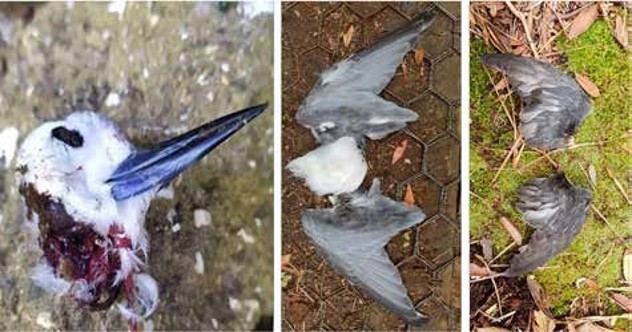
Figure 77. First image shows the remains of a White Tern, the result of cat predation in Wallis and Futuna. Second and third images show the remains of a wing-set of an Antarctic Prion and an unknown seabird species predated by a cat on Auckland Island, New Zealand. Photos: Island Conservation.
Step 4
If you have prior knowledge of the invasive species that may be impacting the seabird species of concern, traps can be placed in or around breeding sites to confirm its presence or absence. Traps should ideally be species specific and housed to minimise risk to non-target native species. Sufficient traps should be deployed to provide confidence that an invasive species is present, and traps may need to be run for a period of time (days to weeks) to confirm species presence.
Trail cameras should be deployed by a trained operator who knows how to position and set up the camera to secure good quality images. Avoiding moving vegetation and or light changes is necessary to avoid generating a large number of images that provide little to no information. Cameras can be set to operate only when seabirds are present and should be placed in breeding areas preferably focused on a burrow or nest site although wider angles may be necessary to detect an invasive species. Cameras can be lured to specifically target an invasive species if you just want to confirm presence or absence.
The use of eDNA is a highly effective tool to confirm the presence or absence of an invasive species but does require knowledge of where DNA is best found in the environment. The method is currently expensive, but costs are likely to diminish overtime. Indicator dogs are extremely sensitive and may be worthwhile exploring if time on site is extremely limited. Thermal detection equipment is also valuable if you are reliant on observations only. Drones with thermal cameras can be used to detect some invasive species within some habitats and may have utility across sites that are inaccessible.
Step 5
Upon return from your site visit or visits, incorporate all data collected into the threat assessment matrix (see example below). This will be valuable to prioritize the need for intervention at the population or species level. As previously indicated, management actions such as predator control or eradication could be refined by additional site visits to secure more specific data. If control is the management tool selected, the sustainability of this option should be considered as benefits can be eroded if control is stopped.53
Eradication of invasive predators, if feasible, is ideal as it permanently removes the threat and often enables rapid recovery of seabirds without any further management intervention. However, eradication is not possible at every site. For many islands, particularly large complex sites, a feasibility assessment will be required to determine whether eradication of the target pest species is possible, considering factors including the limitations of current tools, the scale and remoteness of the site, social acceptability, sustainability of funding and biosecurity (i.e. our ability to defend the site from reinvasion).54
Step 6
If control or eradication is one of the proposed interventions for managing any threats to seabirds, it is also recommended in addition to your threat assessment to conduct a non-target risk assessment to identify unintentional impacts from the invasive predator control or eradication effort to ensure those risks are properly managed through the more suitable non-target mitigation strategy and tactic, as well as understood by all project partners. For additional details and considerations regarding this type of assessment and possible mitigation actions to implement you can review.55,56
Threat assessment matrix example
|
Threat |
Likelihood of occurrence |
Level of impact – population/ species |
Scope |
Severity |
Interventions |
Knowledge gaps |
| Black rat predation of eggs and chicks | High | Population (Floreana) and at species level (Galapagos islands) | 100% (Flo. population) and 60% (species) |
Medium to high without control |
Control with anticoagulant rodenticides on Cerro Pajas (main breeding colony) | Unknown percentage of population breeding outside main colony on Floreana |
| House mouse predation of eggs and chicks | Unknown | Population (Floreana) and at species level (Galapagos islands) | 100% (Flo. population) and 60% (species) |
Low – Medium? |
Control with anticoagulant rodenticides on Cerro Pajas (main breeding colony) | Unknown if the species predate on eggs or chicks |
| Cat predation of chicks |
High | Population (Floreana) and at species level (Galapagos islands) | 100% (Flo. population) and 60% (species) |
High | Secondary exposure to rodenticides | |
| Cat predation of adults | Medium | Population (Floreana) and at species level (Galapagos islands) | 100% (Flo. population) and 60% (species) |
Low- Medium? |
Secondary exposure to rodenticides | Unsure of how often adults get predated by cats |