
2.1.12 Case study - Migration and non-breeding habitat of Beck’s Petrel (PTT)
The Beck’s Petrel is a poorly known, Critically Endangered seabird rediscovered in the early 2000s in the waters off Papua New Guinea. In 2017 an expedition was launched to visit the last confirmed locations of this enigmatic seabird to gather more information on their distribution and attach satellite tags to adult birds in an effort to locate their breeding grounds (which were unknown). During the expedition a single Beck’s was captured at sea off New Ireland Papua New Guinea and fitted with a Platform Transmitting Terminal (PTT) satellite-based device (mounted on the back via a chest harness). The Argos satellite tag deployed uses a Doppler effect to determine best location as the satellite moves overhead. The bird was subsequently tracked for eight months, where it maintained a core distribution off the south-east coast of New Ireland and north of Bougainville for 122 days. During this period, the petrel was also located over land at night seven times - predominantly over southern New Ireland, where the signal was also lost for extended periods suggesting
occupancy of an underground burrow.47
As well as providing data on potential breeding grounds, this tracking study also provided additional valuable information about the species during the non-breeding period. After its prolonged residency east of New Ireland, it rapidly migrated 1,400 km along the northern coasts of New Britain and mainland Papua New Guinea to the waters north of West Papua, Indonesia. As this case study demonstrates, data obtained from tracking studies can shed light on the location of unknown breeding colonies, key foraging areas, and migratory routes for species for which almost nothing is known. By gathering these data, conservation efforts
can then be better focused in the areas where they are needed the most.47
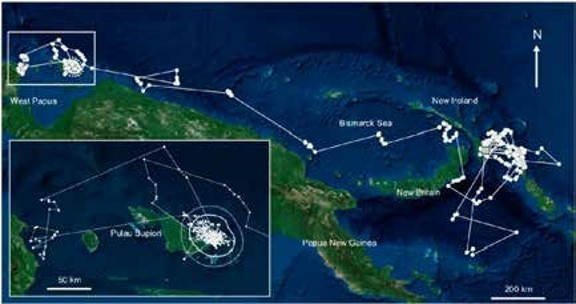
Figure 66. Movements of PTT tracked Beck’s Petrel westwards from New Ireland and the Bismarck Archipelago (capture location shown as grey square) showing core habitat (25% kernel solid white line, 50% kernel hashed white line) off the eastern coast of Pulau Supiori in West Papua. Map source: Rayner et al (2019).